Matlock

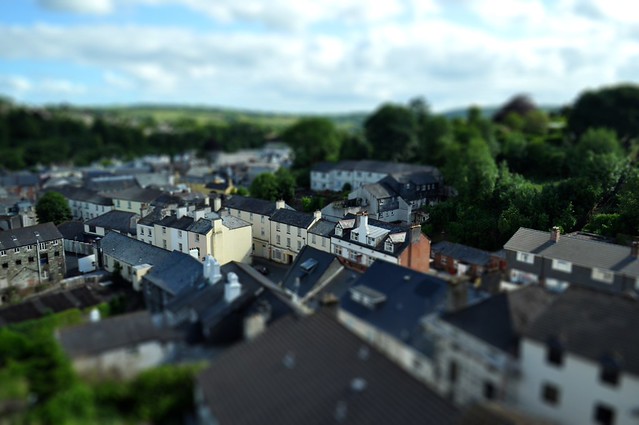
Derwent Valley, Derbyshire, under creative commons by Duncan Harris. Click pic for link.

Derwent Valley, Derbyshire, under creative commons by Duncan Harris. Click pic for link.

Although just outside the bounds of the Peak District national park, you won’t run short of scenery in and around Matlock. The River Derwent, which winds down from the middle of the park, through Bakewell, Matlock, Belper and Derby before meeting the Trent, has carved out an impressive path through the Derbyshire Dales, and the Matlock area is where you find some of the most dramatic parts. Maybe the best way to approach the town centre is from the South, from Belper direction – you’ll follow the Cromford Canal and the Derwent through a UNESCO World Heritage Site of mills and industrial history (I’m pretty much in love with all that at the moment, you’ll have to forgive me) and then pass into the really dramatic gorge around Matlock Bath – stop here for the Heights of Abraham with its cable car – and into Matlock town centre. If you fancy, you can walk all the way, or you can come from the opposite direction on the Peak Rail.

Matlock and its environs were a collection of unimportant villages until the discovery of thermal springs there at the close of the 17th century. With the industrial revolution just a few years after, and Victorian hydro-tourism, Matlock became the bustling county town of Derbyshire, and remains a busy rural town today. What that essentially means for our intentions is that there’s a pile of charity shops, plenty to look at, and something to eat.

If you arrive in Matlock from Cromford direction, you’ll find an Oxfam Books shop as your first charity shop on Dale Road. You’d be well advised to embrace the non-charity sector as well – although there’s one or two smartly priced antiques shops, we’ve found some excellent bargains in Second Time Around, just over the road from Oxfam, including books, blankets, maps and all sorts. Cross over the river and stop to admire the view towards Riber Castle along the Derwent and once again thank your lucky stars that you can come to such a beautiful part of the world. Chuck a penny in the oddly-coloured water of the wishing well, if you’re very grateful.

At the Crown Square roundabout you’re faced with three variably fruitful options. Turn left for the road to Bakewell, Youlgreave and into the Peaks. Along here you’ll find a handily located Wetherspoon’s for breakfast, the Railway Inn for other liquid refreshment (sadly, they seem not to do the breakfasts any more that we enjoyed on our first visit, watching England embarrass themselves in the Rugby World Cup over a plate of sausage and egg), and the slightly odd, crammed-full Lighthouse charity shop. There’s plenty of bargains in here including small electricals, if you can negotiate the over-stuffed room and inconveniently-placed staff.

Go straight up the hill from the bridge, on Bank Road, and you’ll find the majority of Matlock’s civic or historic buildings; importantly, you’ll also find Save The Children, British Red Cross and AgeUK, although you may not find much in them. Alternatively, right onto Causeway Lane will take you along the parks by the river and just round the corner to Firs Parade, home to Mind, Sue Ryder and British Heart Foundation. So that’s a fair haul of eight charity shops in a little town which happens to be one of the prettiest I know. As you can see, I’m in a generous mood, but I’ve no doubt we’ll be returning to Matlock any and every time we’re in the area.

Find: Matlock Google Maps
Get there: you’ve many options – walk the Derwent Valley Heritage Trail, catch the Peak Rail steam train, or get the normal train from Derby.
Consume with: I would have said breakfast at the Railway, but there’s plenty of other options, including the ‘spoons.
Visit: plenty round here! Masson MillsHeights of Abraham, Riber Castle
Overall rating: five china face dolls

Leave a Comment

Filed under 5/5, Derbyshire

Kinver

Sandstone, by El Bingle, under Creative Commons. Click pic for link.

Sandstone, by El Bingle, under Creative Commons. Click pic for link.

There were a few things that sold me on a move to the Midlands, and accidentally driving through Kinver, looking for the way back to Halesowen, was certainly one of them. As soon as burst out of Stourbridge into the Staffordshire countryside you’re already in some lovely territory, and crossing the Stour at the Stewponey Junction you can really feel like you’re out of the big, bad city. Kinver is the very southernmost tip of the county, a large but secluded village nestled in between the River Stour and the Staffordshire & Worcestershire canal (which run parallel on the East of the village) and the promontory of Kinver Edge. It’s these features that defined the village historically. First the Stour, then the Staffs & Worcs brought water-borne trade through the village resulting in several lock-side pubs, watermills and cloth making. Later on some of the country’s earliest slitting mills split bars of iron ready to be made into nails in nearby Lye or Bromsgrove. After that, Kinver became a bit of a proto-tourist destination with the installation of an electric light railway from Stourbridge, and although that’s closed, it’s still a popular spot amongst locals for a wander round and a sit in the sun by the river.

Most curious are the Holy Austin Rock Houses. Built into the caves of Kinver Edge (now a National Trust-owned high heathland and forest), these troglodytic caves were continuously occupied right up to the 1950s, and some have been restored to their Victorian glory, replete with windows, ranges and furnishings. Evidence of prior occupation is found higher up the hill with its Iron Age earthworks, and get right to the top for impressive views over Worcestershire, Staffordshire and Shropshire, belying the Edge’s actual fairly low altitude.

Be aware: Kinver is just a village. It’s got a good stock of little shops, reminiscent of Alresford in some ways, with some boutiques and tea rooms, and a couple of excellent pubs: I recommend The Vine (whenever it reopens) on the canal. There’s just the two charity shops. Compton Hospice is a fairly standard little shop – it seems like there’s rarely enough room for everybody that wants to be there. There’s occasionally a treat though – finances sadly dictated that we say no to a whole boxful of antique medicine bottles that had been donated. The better shop is (as often) Mary Stevens Hospice. This is a big, two-level shop with a good selection of clothes and shoes, some small furniture (we got a little bedside here) and a stack of knitting supplies, which I’m told is very modern.

And that’s it. You don’t come to Kinver for a full-on retail experience, but for the tranquil village-ness, the frankly lovely surroundings, and a quiet potter in the little shops. It makes an excellent stop on the towpath walk, or a stopping point on the way to Bridgnorth and the hills.

Find: Kinver Google Maps
Get there: Kinver has no rail or anything, but there’s buses from Stourbridge. The nicest way is to walk, which you can do in a couple of hours from Kidderminster along the canal, for instance.
Consume with: plenty of tea rooms vie for your attention. Try a hot pork sandwich from the Dunsley Hall tea rooms.
Visit: the Rock Houses and Kinver Edge, for sure.
Overall rating: four stitch savers.

Leave a Comment

Filed under 4/5, Staffordshire

Pershore

Pershore Abbey, under Creative Commons. Photo by Timothy Rose, click pic for link.

Pershore Abbey, under Creative Commons. Photo by Timothy Rose, click pic for link.

Surprising (to me) as it may seem, I’ve yet to sit down and plan trips out on the basis of one road. At some point, however, I’d like to be able to write down my experiences of the A44 - an otherwise undistinguished route between Oxford and Aberystwyth, this ploughs through a great deal of what I love about the English countryside and its accompanying towns, then takes a nice hike through the mountains of mid-Wales to its final destination in the Irish Sea. For future reference, expect detailed accounts of the A449 from Stafford to Newport, the A458 stretching from home turf into deepest Snowdonia, and when I feel really brave, the A38.

Oxford is a destination that we’ve achieved once, and have been thwarted by breakdowns, newborns and all sorts in our attempts to revisit. It remains a future write-up, as do the Cotswold towns of Chipping Norton and Moreton-in-Marsh, which are to come much more quickly. After Evesham, Pershore is the next decent-sized (read, CST-relevant) town along the road. After that would come Worcester, Bromyard, Leominster (recently scoped out), Llanrindod Wells, Rhayader, and finally Aberystwyth – our hopefully-soon-to-be-purchased caravan might help add some of these names to our visited list.

Situated on the river Avon on its way to meet the Severn at Tewkesbury (also coming soon), Pershore is at the heart of one of the most fertile fruit-growing regions of the country (as evidenced by the annual Plum Festival, which will undoubtedly *cough* be on our list of to-do’s in 2012). Entering via a bridge over said Avon, the most notable sight is the restored Benedictine Pershore Abbey on the Western side of the town centre. You could park along the road here, or as we did around the corner at Asda, from whence a profitable and pleasant charity shopping trip. If you park in Asda, you’ll have the added convenience of being dead close to two large St Richard’s Hospice shops – one for clothes, another for small furniture and a vast array of crockery, kitchenalia and assorted bric a brac. Be warned – there’s some nice things here, but they may not be high up the bargain scale.

On the main drag, there’s a significant-sized Oxfam and an equally well-sized Blue Cross shop. Just off the high street on Broad Street is a poky but well-filled Cats Protection League – I found a pair of Levis here for £4 (a miracle because of my odd proportions), which was excellent until we got home and saw just how green they were. They’ll need consideration; possibly dying.

The pick of the bunch is Acorn Hospice. This is a huge shop with a couple of side rooms for various things. It’s not so much that they stock anything unusual, just a large quantity of it. This is particularly evident right at the back, where books are piled wall-to-ceiling and weigh down a large table as well. Six is not a bad haul for a town as little as Pershore, so it punches above its weight. It has a great location for us, as it could easily be combined into a big old day out by hitting up Worcester, Upton and Malvern as well, even Tewkesbury for the adventurous (I wouldn’t bother with Evesham). And it’s nice! A polite, charming little town with some things to see and do. Good work.

Find: Pershore Google Maps
Get there: Pershore station is on the Worcester to London line, so stops in all sorts of helpful spots.
Consume with: the standard cheese baked potato, in Sugar and Spice, was fairly basic but went down well. Don’t ask for something off menu though, you’ll enter a world of pain.
Visit: the abbey or Bredon Hill would make good trips.
Overall rating: four Peter Gabriel LPs

Leave a Comment

Filed under 4/5, Worcestershire

Keswick

Jus' walkin' the dog by Rick Harrison, used under Creative Commons. Click pic for link.

Jus' walkin' the dog by Rick Harrison, used under Creative Commons. Click pic for link.

As with our last weekend away, we didn’t pick a good time to put our undoubtedly good intentions and underused walking boots to use when we took a couple of days to visit the Lake District. This time, instead of rolling fog and drizzle, we had to contend with the aftermaths of laryngitis, colds and coughs, as well as the first substantial snowfall of the year snarling up the M6 through Staffordshire. It did, however, make the Cumbrian mountains that much more spectacular, all the more so to a first time visitor like me. As we drove towards Keswick from our hotel, through Kendal, Windermere and Ambleside, past a snow-capped Helvellyn, with Coniston Old Man behind us, it was really something quite spectacular. I can’t really think of an approach to a town that can compare in this country: perhaps the descent into Killarney from the national park would be a challenger, but it would be splitting hairs.

Once in the town, you’ll certainly find yourself in the company of large numbers of appropriately clad walkers. Clutching battered Wainwright guides and dressed in gaiters and waterproofs, the fully experienced rambling hikers of the Lake District congregate in Keswick for a tea and scone or pint of ale, before heading out again. We felt somewhat underdressed, but made the most of the Mountain Warehouse sale to cover some of the ground. Same as when we hit the Peak District, this visit was a reccy – we already have a return visit booked for March, and will break out the rambling hiker gear then. Probably we won’t set our sights as high as Helvellyn, but we’ll do our best.

The next challenge, after the professional ramblers have been successfully evaded, is trying not to spend all ones money in secondhand map shops. This is becoming more and more of a challenge, and will continue to be a problem as long as I keep buying up old Bartholomew maps and the like. Soon to come at CST is Tewkesbury, which seems to be trying to lure me in with exactly this, but it was actually Keswick that yielded up the home turf – under the patronage of the “late King George V” and in beautiful shades of brown and green, the Vale of Severn is opened up from Birmingham across to Clun – including Stourbridge, the Black Country (with fields!), Worcester, Bridgnorth, and so on (I’d best halt here before getting carried away…). This was in a sprawling upstairs bookshop on Station Street, and it’s not the only one: beware. Beware too the vast numbers of outdoorsy shops – there is literally every single one here.

Most pertinently, beware of your wallet when you arrive at Oxfam. This is one serious charity shop, though certainly a most pleasant one. Rather than separate book and other shops, this is a large, combined store. There’s a significant book section (including a large religious section if that’s your thing – this is, after all, Keswick of Convention fame) and a very well-stocked music section. Vinyls are arranged by genre, which is a good sign in a record shop but a bad one in a charity shop: it’s an indicator that staff know the values of their goods, so bargains are rare. This suspicion was borne out by a £30 copy of Pink Floyd’s Ummagumma, and £16 for After The Goldrush. Never mind. You might find a bargain amongst the huge array of vintage cameras, however: we walked out with a Kodak Brownie 127 for a cheerful £6.99. There’s also rails of clothes, vintage exercise bikes(!), record players and such.

A top notch, though expensive, charity shop, not many others could match up – and Barnardos, the only other circus in town, definitely doesn’t. Few items of interest here, sadly. Despite the paucity of charity shops, Keswick is worth a visit for so many other reasons, I can’t give it a low score – in fact, I enjoyed the town much more than a three would indicate, but this is a charity shop blog, after all…

Find: Keswick Google Maps
Get there: Train or 555 bus from Lancaster, or drive from Kendal, Penrith etc… but the slower the better to appreciate the surroundings, so maybe join the mob and walk here.
Consume with: we had a rather excellent baked potato at Laura in the Lakes, but there’s plenty of sustenance to go round.
Visit: get out of town – you’re in spitting distance of Derwent Water, Skiddaw, Grisedale Pike and many more.
Overall rating: three box brownies


Leave a Comment

Filed under 3/5, Cumbria

Bridgnorth

Signs, used under creative commons licence, by R~P~M. Click for pic.

Signs, used under creative commons licence, by R~P~M. Click for pic.

CST’s first foray into the wilds of England’s largest inland county is a somewhat tentative one, but is definitely not the last. Going West from our new home we leave the West Midlands via a little Worcestershire and a little Staffordshire, but as the altitude rises towards the Welsh Marches we hit South Shropshire. Whereas the North of the county sweeps through from the Cheshire plains to the industrial heartland of Shrewsbury-Telford-Ironbridge, the South of the county is dramatic, rugged and massively rural. Bridgnorth is about the biggest settlement in the area, with huge gaps between civilization. To go any further West the intrepid charity shopper must set out over Wenlock Edge, Longmynd, the Clee Hills and more, looking on towards the mountains of Wales. Ideal for the fully experienced rambling hiker.

Bridgnorth itself is a bustling little burgh, an old and historic country town. There’s antiquated civic buildings on legs, city gates and the like. The most notable feature is the town’s split level – the high town and the low town. Approaching this as though you’d be making a day trip to Bridgnorth, the following is the recommendation. From Kidderminster (coming soon) take the Severn Valley Steam Railway through Bewdley and the Wyre Forest, terminating overlooking the Severn in Bridgnorth. Have a wander along the riverbank until you reach the large old bridge, and the low town spans either side of this. While there’s no charity shop action, there’s plenty of room to sit and have an ice cream, watching the Brummies on vacation that tend to throng the town on sunny days – bikers too. From there a pound will buy you a return ticket on the funicular railway, the steepest of its type in the country, no less.

The little railway drops you around the back of the town, next to the castle (which, trivia fans, leans at four times the angle of the leaning tower of Pisa), from where it’s just a short walk round the corner into the high street. There are four charity shops along here. They’re unremarkable, to be honest, and if you go on a Saturday they are sure to be heaving. For a start, the Saturday market butts right up against the pavement, causing all manner of crush for pedestrians. (Make sure you have a full explore of the market though, right around the back to near the supermarket, as there’s all sorts of fun tat to be found. The Old Curiosity Shop is worth a rummage through for army surplus and various randomness, and follow the road round for a lovely, sprawling antiques centre.)

Along the High Street you’ll find Oxfam, Hope House Hospice and British Red Cross, and at the end of the road, Cancer Research. The best of these is probably the Red Cross shop, which sported a nice looking accordion last time we were in.There’s nothing which sets Bridgnorth out as a charity shop Destination, really, but that’s only half the point isn’t it? On the tourism front it’s great fun, especially if you can time your visit to arrive on a 1940s recreation day when the town is swarmed by vintage uniforms…

Find: Bridgnorth Google Maps
Get there: if you can find the fare, go on the steam train!
Consume with: plenty of choice in terms of pubs, cafes and chippies along the high street.
Visit: the leaning castle would be worth a look around.
Overall rating: three RAF uniforms.

3 Comments

Filed under 3/5, Shropshire

Droitwich Spa

Droitwich floods 2007 (2) by Ruth Flickr is used under Creative Commons. Click pic for link.

Droitwich floods 2007 (2) by Ruth Flickr is used under Creative Commons. Click pic for link.

In theory, there’s no reason why Droitwich Spa shouldn’t be a perfectly pleasant little town. Though home to a significant swathe of commuter development from the sixties onwards, Droitwich is its own community with its own salt-working industrial heritage stretching back to Roman times, when the town was called Salinae. The natural water of the town is ten times saltier than the Dead Sea, no less, and that led to DS becoming a Victorian spa town known for the restorative properties of a dip in its waters. Situated on the River Salwarpe and the Droitwich Canal, directly between the edges of urban Birmingham and the medieval splendour of Worcester, I repeat: there’s no reason why this shouldn’t be a lovely little town.

The problem with Droitwich is hard to pin down. Despite its Roman, medieval, Victorian and Edwardian heritage, the town centre is drab and lifeless. A sunny Saturday afternoon should bring the best out of a town, but this oddly warm October day saw a very few disinterested shoppers poking at a collection of pound shops and budget-end retail chains. The rail station is somewhat out of town, leaving some buses for the intrepid few. But why go to the effort of going into Droitwich when you have the full gamut of shopping facilities just a few miles down the road in Bromsgrove, Worcester or Birmingham?

Droitwich has it’s share of charity shops. On St Andrews Road there’s a mid-sized Salvation Army and a Blue Cross, next to a fairly massive, crowded secondhand furniture shop which is worth mentally tucking away. In the St Andrew’s Square shopping development, which seems to be what life there is to the town, there’s also a very standard Cancer Research shop. The rest of the shopping stretches down High Street – there’s one or two secondhandy shops, some quiet looking delis, that sort of thing, alongside Acorn Hospice and St Richard’s Hospice, which is hidden down a little side road towards the big Waitrose.

We didn’t come away with any purchases of note on that unseasonably hot Saturday afternoon, and in no way feel tempted to give DS a second chance, if only for the intense difficulty of finding something nice to eat for a late lunch. The town has potential in all its history, but needs some serious work to make it a viable destination for anything.

Find: Droitwich Spa Google Maps
Get there: the trainline is a little bit out of town, buses are occasional and walking is hard. Sigh.
Consume with: good question! You find me the answer and I’ll let you know.
Visit: the classy amongst you might enjoy the famous Droitwich Spa Lido.
Overall rating: two (just!) damaged headphones.


Leave a Comment

Filed under 2/5, Worcestershire

Bakewell

Bakewell Street, by Dave Pearson, under Creative Commons. Click for link.

Bakewell Street, by Dave Pearson, under Creative Commons. Click for link.

One of the glories of moving away from the all-consuming monetary monster of the South East is that other places are so much closer. There’s a reason it’s called the Midlands – it’s in the middle, making so many places so much more accessible. I never really noticed at first: it’s easy to get caught up in a London bubble, but try and get out and it’s hard work. Negotiate the clogged arterial roads and you meet the more-clogged M25. Find your way out of that and you’ll likely be on a roadwork-heavy M1 or a thronging M4. Travel for half an hour in London and you’ll be half a mile from your starting place. Travel for half an hour in the Midlands, even at rush hour, and you’re halfway to your weekend holiday destination.

Hence a pleasant weekend away in the Peak District, just over an hour away. Typically for an October weekend, this was not the best time for sightseeing – the fog rolled in on Friday night and little could be seen. We pressed on boldly though: while the Peaks are undoubtedly prime hiking territory (on clearer days), we weren’t sure where to begin, so this little time away afforded an opportunity to scope out the area and make some plans for next time. Staying (on a Travelodge cheapie deal) at Alfreton, Bakewell was on our journey into the peaks, and was a worthy stop.

There’s a general rule of thumb when you’re visiting a town: if it’s a bit scenic; if it’s set in beautiful countryside, ripe for walking; if it’s raining: try somewhere else. Not that there’s anything wrong with Bakewell, but on a foggy, damp early October weekend, it was heaving. Nestled into the White Peaks, Bakewell is very much the quaint English country town. Now replete with Edinburgh Woolen Mill and copious walking shops, it caters to the sensible trouser-clad hiker and the epicurious as well – it’s not every town that can lay claim to its own pudding.

Let’s get the pudding out of the way. A Bakewell pudding is not a Bakewell tart. The tart so familiar through Mr Kipling‘s marketing endeavours is a shortcrust pastry filled with jam and a ground almond-based sponge. The pudding, which will take you by surprise if you’re not expecting it, is a hot thing served with custard or cream, a puff pastry base containing  a little jam and a pile of almondy egg custard. The variants are served up by the main competitors in town: the Old Original Bakewell Pudding Shop and the Bakewell Tart Shop and Coffee House. We ventured into the former and eagerly awaited our hot snack, but confess disappointment – slimy and odd. I’ll be sticking with the wife’s homemade version, which is a pile better. (To be fair to the Pudding Shop, it was a gorgeous building with a lovely deli downstairs which sent us away with a locally-brewed South Pacific Pale Ale.)

If you don’t fancy that strange confection, there’s plenty of tea-room/coffee-house based choice, whether you want modern funky cafe, or Austrian-themed coffee rooms with chaffinches in the rafters. These fit comfortably into the gaps between chunky jumper shops and stout walking shoe shops and, of course, charity shops. The first you’ll see is Mind which featured, if nothing else notable, Rupert Bear Christmas cards. After this, tucked away in the back are an Ashgate Hospice shop, Derbyshire Air Ambulance and AgeUK. These shops were packed out (and poorly laid out…), but still we got a nice velvety jacket (we both, apparently, are suckers for a brown velvety jacket).

Bakewell is pretty lovely really, if you’re not of the violently misanthropic variety: be warned, it’s a tourist town but it’s very pretty, very tasty, and in unbeatably lovely surroundings.

Find: Bakewell Google Maps
Get there: no train link, thanks Dr Beeching – it’ll have to be bus.
Consume with: while the many coffee shops were lovely, I was sorely tempted by the excellently-named Pizzakebabwell.
Visit: You’re right in the heart of the white peak district here, so take your pick. Monsal Dale is a regularly-recommended walk.
Overall rating: three chunky jumpers

2 Comments

Filed under 3/5, Derbyshire

Ross-on-Wye

Ross on Wye, Herefordshire, by Cross Duck. Picture used under Creative Commons, click pic for link.

Ross on Wye, Herefordshire, by Cross Duck. Picture used under Creative Commons, click pic for link.

Sitting in the bar of the Royal Hotel overlooking one of the Wye’s circuitous meanders, munching on fish and chips and generally wiling away time is, it turns out, an extremely pleasant way to slow down a Saturday afternoon. Typically for an English summer’s day, the fluffy clouds of lunchtime turned into a damp afternoon in Ross; later on, a plucky country music festival on the grass below will be entirely flooded by a massive thunderstorm – I suppose par for the course when you’re this close to Wales.

Ross considers itself a home of the British tourist trade – the first guided boat tours took in the Wye from Ross, the first tourist guide was published in 1782 about the river. It’s no wonder, really: situated on the edge of both the Forest of Dean and the Herefordshire countryside, Ross is a stone’s throw from the Malverns, the Black Mountains, the Bristol Channel or the cathedral cities of the West Country. And Ross itself is a desperately quaint little market town with pride in itself and its environs. Helpfully, it’s bursting with charity shops, making even a rainy stop-over worthwhile.

The town centres on its stilted Market House at the top of Broad Street. From there you can proceed uphill along the High Street towards St Mary’s church, the Royal Hotel or the Phoenix Theatre, past an array of locally run, independent shops. Particularly interesting looking were Waterfall Antiques, and Truffles deli, stocking an impressive 90 local ciders, arranged by distance from the shop. The opposite direction is Gloucester Road and here you’ll find St Michael’s and Acorns hospice shops. The former provided me with a speculative purchase of a Henning Mankell novel, introducing me to Inspector Wallander, off of the telly. Let me go on the record now to state that it was rubbish.

It’s the steep main drag, Broad Street, that houses most of the charity shops. You’ll find British Heart Foundation, Barnardos, Oxfam, Sue Ryder Care, Cancer Research and AgeUK lining the street and if you can’t find a bargain in there, you may well be blind. Ross is a tiny town that punches well for charity shops. It’s certainly one of the most agreeable visits you’ll find location-wise and you’d be daft not to have at least a little look.

Find: Ross-on-Wye Google Maps
Get there: Ross is a little bit like hard work if you haven’t got a car: you’ll need the train to Ledbury, though there’s plenty of buses from there.
Consume with: we had lunch at the Royal Hotel – perfectly serviceable, great location, decent price.
Visit: like history? Try Goodrich castle. Like nature? Try Symond’s Yat. Like walking? Try the Forest of Dean. And so on.
Overall rating: four Fat Face shirts.

2 Comments

Filed under 4/5, Herefordshire

Stourbridge

Arches by Nickster 2000, used under a Creative Commons license. Click pic for link.

Arches by Nickster 2000, used under a Creative Commons license. Click pic for link.

Today, you’ll find Stourbridge as the westernmost compass point of a sprawling West Midlands conurbation, butting right up against some glorious Staffordshire/Worcestershire/Shropshire countryside. But it wasn’t always so: the Black Country isn’t like London with its endless 1930′s ribbon developments radiating out from the centre; rather, each town is a definable centre, each with a purpose (at least, orginally). Cradley is called the home of chain-making, Walsall’s famous for its leather trade, Wolverhampton for its steel. Stourbridge is no different and became, particularly during the nineteenth century, a world centre for the glass industry after significant Huguenot in-migration. The twenty-first century is a very different era and the Black Country is becoming a post-industrial society – though certainly not out of choice. Stourbridge retains an artisan-led glass quarter (around Kingswinford and Amblecote), but today finds itself as much a dormitory town for Birmingham, just the other side of the M5.

Stourbridge holds a particularly happy place in this blogger’s heart, however: it’s where he and his Charity Shop Partner (slash wife) have just moved, so chances are you’ll be hearing plenty more from the West Midlands and its environs over the next few months. Its location right on the edge of the countryside makes it a very appealing place to live – as accessible for the urban delights of Birmingham as for the craggy heights of Shropshire or the Malverns. If we fancy a breath of fresh air these days, we don’t have to drive to a gloomy Essex coast or wander through a crowded Epping Forest: we can ascend the overlooking Clent Hills and have our breath removed by a view spanning to Wales or the Cotswolds.

But that’s enough about me – more importantly, this is a charity shop shopping blog and has its priorities. Happily, Stourbridge punches pretty well. In a less touchy-feely era of civic government than our own, a Nascar styled ring road (see below) was built around the town centre and it’s within the ring road that you’ll find the bulk of the town’s shops. Note though – there are other charity shops scattered around, notably a couple in Wollaston that I may or may not touch on another time. Within the pretty attractive town centre I count a good nine charity shops as well as various other amenities and local shops. You wouldn’t come to Stourbridge for a day’s shopping experience any more, as you wouldn’t go to Dudley, Brierley Hill, Halesowen, or any other community within the catchment area of the monolithic Merry Hill centre, so be warned of that.

There’s a stretch of charity shops on the High Street including a pretty sweet and not-too-expensive Oxfam: we located a pile of cheap Jo Nesbo books and, happily, three Granta magazines for £1.50, which are now populating the landing bookcase. Having brokenheartedly sold several hundred books in the move, we now appear to be doing our best to counteract that. There’s also Barnardos, Marie Curie, Acorn’s Hospice and British Heart Foundation, and best of all the huge Mary Stevens Hospice Shop, fundraising for the hospice which is located in Stourbridge itself. There’s a second huge Mary Stevens shops in Victoria Passage, a sneaky cut also containing cafs, restaurants and little boutiquey shops. This Mary Stevens, as with the main one, sells plenty of furniture as well as clothes and books – the one on the high street has an entire upstairs bookshop. Look out for cast iron fireplaces and patio sets. On Lower High Street you’ll find Cats Protection League, just up from King Edward VI college – educators of Robert Plant and Samuel Johnson, no less. Then back up Market Street to find Happy Staffie Rescue and Scope. That just leaves the very mid-century Ryemarket Centre where you’ll find Waitrose and Smiths and the like, as well as PDSA and Salvation Army.

While Stourbridge is hardly remarkably beautiful or noteworthy, it turns out that it’s a very pleasant place to wile away some time. It’s a bustling little town centre with some gorgeous buildings – King Eds, the Town Hall and St Thomas’ church are all very attractive. It makes a great stop on a day out to the country as well – it’s only a short hop from here to Bridgnorth or the Wyre Forest. Best of all, a whole heap of charity shops – if this was the Grandstand vidiprinter, that would be 11 (eleven).

Find: Stourbridge Google Maps
Get there: Plenty of buses end at the bus station, and you also have the shortest branch line in Europe terminating at Stourbridge Town with its funny little trains.
Consume with: There are plenty of coffee and food places around – there’s a Caffe Nero, and The Well looks quite nice. If you’re willing to expand your horizons, there’s many pubs doing a wallet-friendly £3.69 carvery (The Old White Horse), some doing some lovely food in a lovely location (The Vine, Kinver) and of course, plenty of curry (I recommend Balti Bazaar in Lye).
Visit: The Glass Quarter is full of museums and things to do – the Red House Cone is basically a big red cone for making glass, and if glass is your thang, you’ll find plenty of interest at Broadfield House or the Ruskin Glass Centre. If not, take a wander along the canal or to the lovely Mary Stevens Park.
Overall rating: five antique fireplaces

3 Comments

Filed under 5/5, West Midlands

Hiatus

Charity Shop Tourism is, as is pretty evident, on a short break at the moment. This is mostly due to a house move which will hopefully mean a whole lot more destinations coming soon, as it’s a relocation away from the Big Smoke to the fresher air of the Midlands and a whole plethora of new charity shop destinations. Until then: bear with.

Leave a Comment

Filed under News